In the space of three weeks this August, two disasters on opposite sides of the world delivered the same lesson in different languages. A magnitude 7.4 earthquake tore through Chocó in western Colombia, killing more than 300 people and reducing tens of thousands of homes to rubble. Days later, a glacier collapsed onto a mountainside in Nepal, sending a wall of mud and water 100 kilometres down the Trishuli river system, killing hundreds and leaving more than a thousand people missing. Bridges vanished. A highway linking two countries disappeared under debris. Entire villages went silent within minutes.
Uganda watched both unfold from a safe distance. It should not feel far away.
Sixteen years ago this coming March, a landslide tore through Nametsi village in Bududa District on the slopes of Mount Elgon, killing more than 300 people and burying homes, farms, and families under tonnes of mud and rock. It remains one of the deadliest disasters in Uganda's history. Government relocated hundreds of survivors to Kiryandongo District, betting that distance from the mountain would buy them a safer future. Sixteen years later, many of those survivors are drifting back to the same unstable slopes, pulled by land, by livelihood, by the simple fact that a resettlement scheme cannot outcompete the pull of home. This year's government forecast has again flagged the lower Elgon slopes, along with Butaleja and Kasese, as high-risk zones for flooding and landslides during the current rainy season.
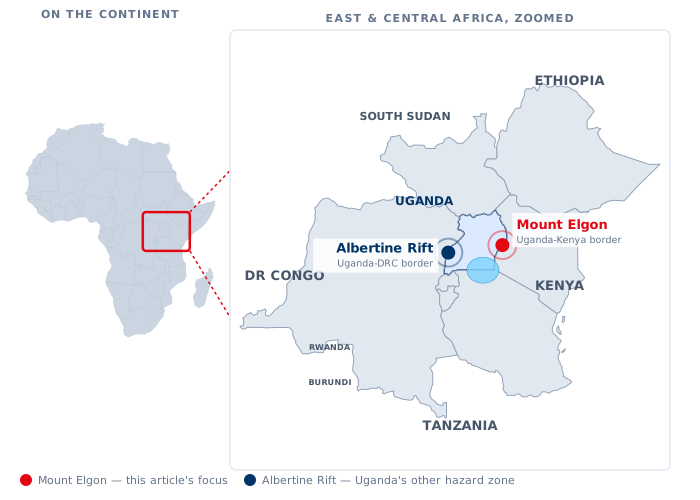
The pattern connecting Nepal, Colombia, and Uganda is not coincidence. It is three variations on the same equation: steep or seismically active terrain, a population with nowhere else to farm or build, and a climate signal that is loading the dice. Nepal's disaster was triggered by glacial melt, itself a symptom of a warming Himalaya. Uganda's own hazard belt runs down the Albertine Rift and the slopes of Elgon, where the World Bank has warned since 2021 that heavier rainfall is loosening ground that was never stable to begin with. Kenya's escarpments, the DRC's Kivu highlands, and Ethiopia's highlands share the same profile. This is not a Uganda problem or an Elgon problem. It is a regional geohazard belt that happens to run through some of East Africa's most densely settled and, in places, most fragile ground.
That last word, fragile, is where this stops being purely a humanitarian story and becomes a stability one.
Disaster displacement rarely happens in a vacuum. A landslide that pushes several thousand people off a slope in a region with secure land tenure and stable local governance is a logistics problem. The same landslide in a region already strained by land disputes, cross-border pastoralist tension, or weak local authority is something else entirely: a shock that can tip existing fault lines into open conflict, or hand recruiters and spoilers a fresh grievance to work with. Anyone who has spent time in DDR, CVE, or stabilization programming in northern Uganda, South Sudan, or the DRC has seen this mechanism up close. Displacement erodes livelihoods. Eroded livelihoods erode trust in government. Eroded trust in government is exactly the soil that instability grows in.
Colombia and Nepal, for all their devastation, responded with functioning national machinery. Colombia's disaster risk agency and military mobilised within hours, declared a national disaster, and rolled out rental subsidies and tax relief for affected families. Nepal's Home Ministry and army had helicopters over the flood zone in a similar window. Uganda's own record on Elgon tells a more sobering story. A 2024 assessment of landslide early warning systems in Bududa found that only about a tenth of surveyed residents rated the system as more than modestly effective, and researchers have pointed for years to institutional vulnerability, inadequate financing, and weak enforcement of settlement restrictions as the real drivers of repeat disaster in the region, not merely bad luck with the weather.
That is the gap worth naming plainly: not the frequency of the hazard, which Uganda cannot control, but the thinness of the institutional response to it, which Uganda can. Every relocation scheme that quietly fails, every early warning system residents do not trust, every rainy season that passes with the same high-risk districts named and the same limited follow-through, is not just a disaster preparedness failure. It is a slow erosion of the government's credibility in exactly the places where that credibility is already thinnest.
Uganda does not need to wait for its own Chocó or Rasuwa to take this seriously. The warning signs, and the warning forecasts, are already published. What is missing is a shift in framing: treating landslide and flood risk on Elgon, in Karamoja, and along the Rwenzori not purely as a humanitarian relief problem, but as a slow-onset driver of the same vulnerabilities that stabilization and peacebuilding work already spends millions of dollars trying to address elsewhere. Climate-driven displacement and conflict-driven displacement end up looking remarkably similar on the ground: broken livelihoods, contested land, and communities asking why the state showed up too late, if it showed up at all.
Nepal and Colombia will spend years rebuilding roads and bridges. Uganda has the rarer opportunity to act before its bridges wash away. Whether it takes that opportunity, or waits for the next rainy season to make the decision for it, will say as much about the strength of its institutions as any landslide ever could about the strength of its mountains.